Match racing's king
Lymington’s sailor extends record championship reign in Shenzhen
By Benji Sampson
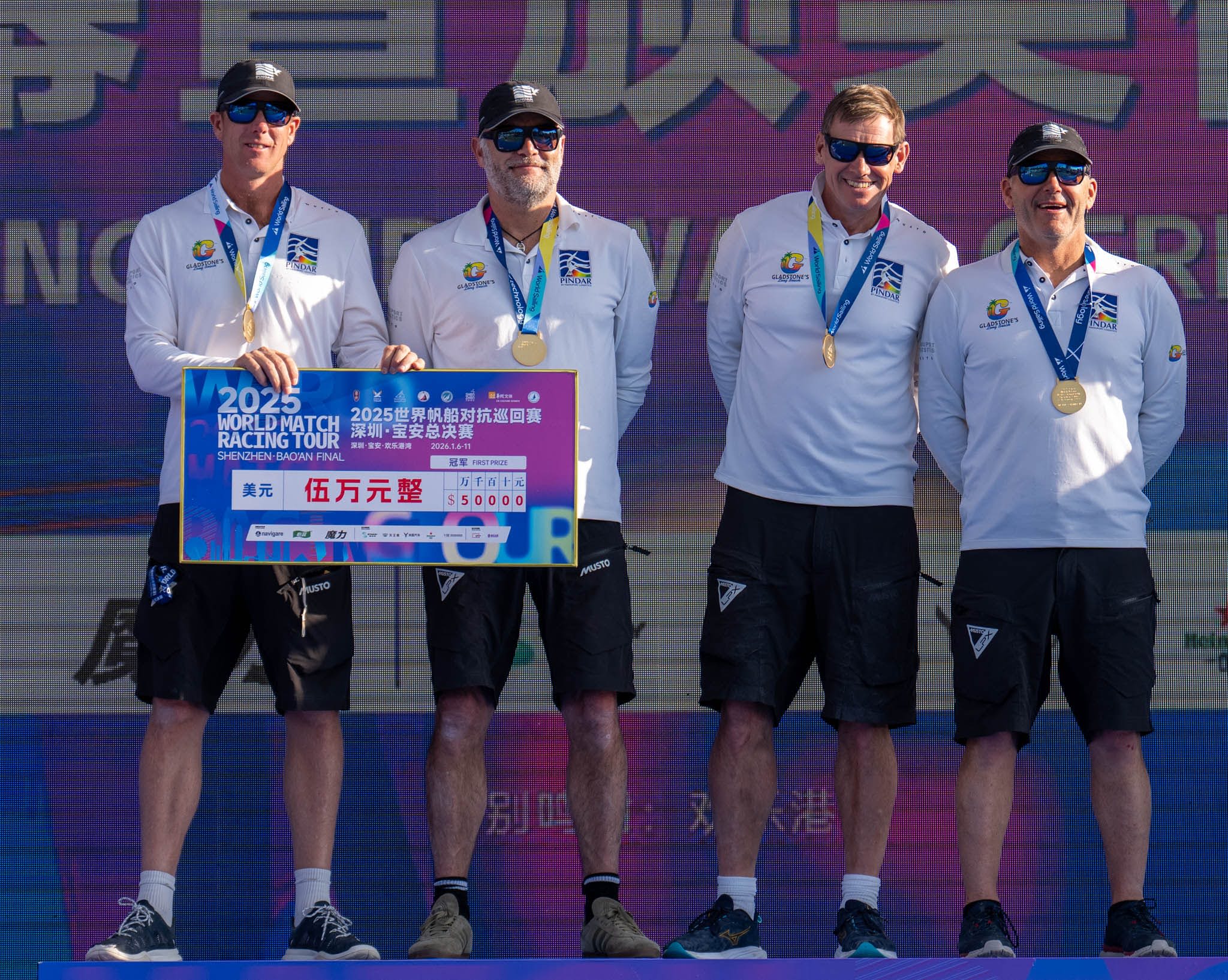

Ian Williams, aged 48, won the World Match Racing Tour (WMRT) final in Shenzhen.
Williams has never been one for loud statements, once described as “one of the greatest sailors you’ve never heard of.”
Yet in Shenzhen, his results spoke louder than ever as the 48-year-old claimed a record ninth Match Racing World Championship title.
“It’s incredible for us to get to nine Match Racing World Championship titles,” Williams said. “When I started match racing 30 years ago, the goal was to win a world title, so to be at nine is incredible,” Williams said.
Across nearly two decades at the top of match racing, Williams’ reputation has been built on control, timing and an ability to win when it matters most.
He has now lifted world titles in 2007/08, 2008/09, 2011/12, 2012/13, 2014/15, 2015/16, 2023/24, 2024/25 and again in the 2025/26 season. He has become the only sailor to win three championships back-to-back-to-back.
“It’s a funny one,” he admitted. “The six beforehand all came in pairs, 2007 and 2008, 2011 and 2012, then 2014 and 2015. There was that monkey on our back about whether we could do the three-peat, so for sure it’s hugely satisfying.”
The setting for the historic ninth title was fitting. Shenzhen’s modern skyline and tight inshore racecourse provided a demanding backdrop that tested nerve as much as technique.

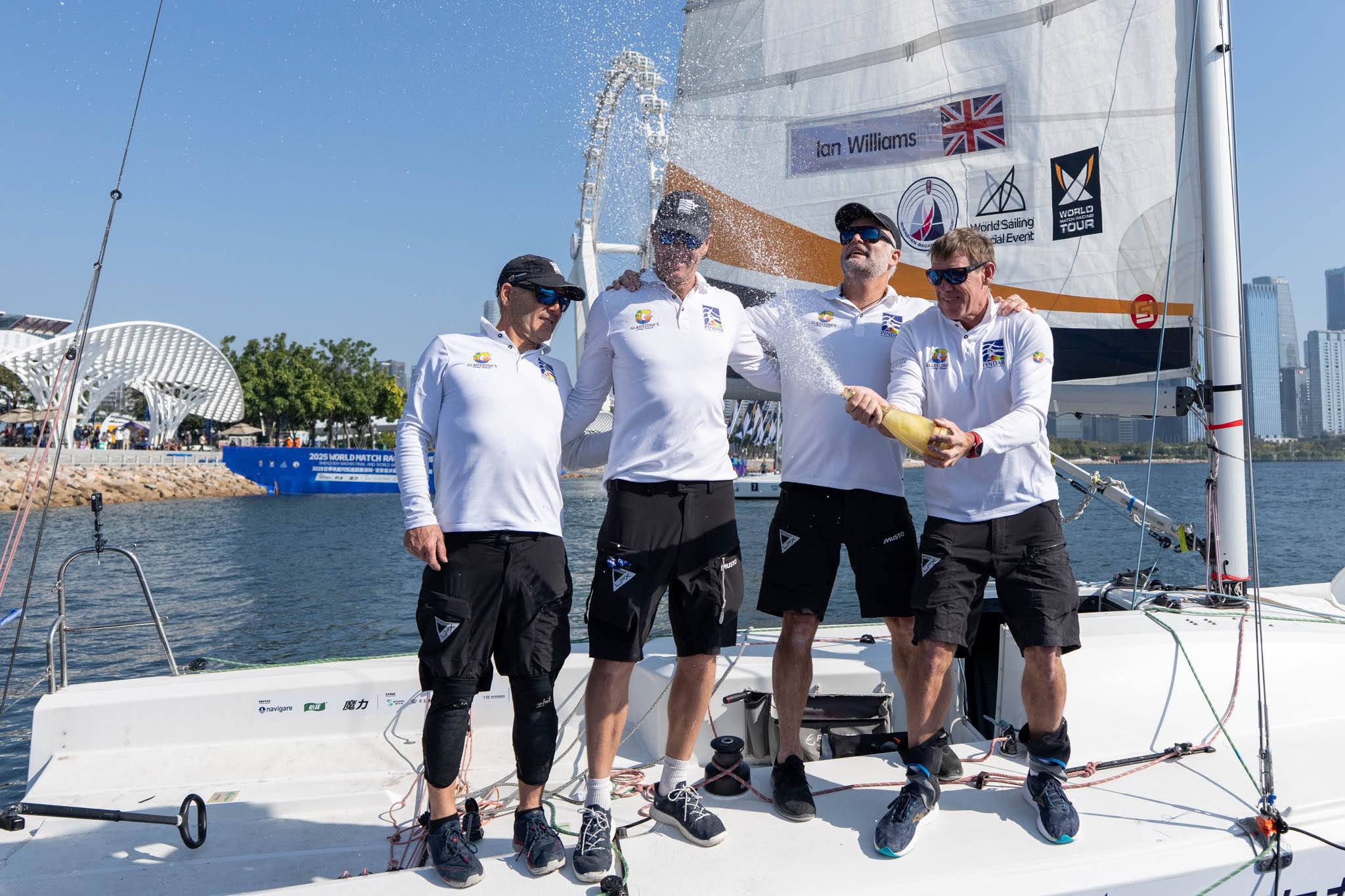
Light airs early in the week gave way to shifty, pressure-filled conditions as the event reached its decisive stages.
“The conditions in Shenzhen are really challenging,” Williams explained. “It’s a very developed city, with several 300-metre-plus buildings close to the racecourse,” Williams added, “When the wind blows off the city it’s really shifty and fickle. But it’s the same for both boats, and it becomes all about risk management.”
From the opening round-robin races, Williams looked comfortable. His starts were sharp without being reckless, his boat handling precise and his tactical calls measured.
While younger rivals pushed hard for early dominance, he focused on consistency, building momentum race by race.
That approach paid off as the regatta tightened. Knockout sailing leaves little margin for error, and several high-profile teams fell victim to penalties or a single poor manoeuvre.
Williams, by contrast, remained composed, resetting quickly even when races swung against him.
“It’s really about having that professional approach,” he said. “You analyse after every day, keep looking for things you can do better, review footage and watch other teams, especially younger teams that bring innovation and new ideas.”
Central to Williams’ continued success is the familiarity and trust within his crew, a group built over years rather than seasons.
“I sail with Richard Sydenham, John Gunderson and Jerry Mitchell,” Williams said, “Richard I’ve been sailing with on and off for 30 years, Jerry’s been with the team since 2005, and John is quite new, he’s been in the last three years.”
That blend of long-standing relationships and fresh input has become a quiet strength, allowing the team to operate with instinctive understanding under pressure.
“I know those guys really well, I know their strengths and weaknesses, and they know mine too,” Williams added. “That’s one of our strengths as a team.”
The final stages underlined why his record is now unmatched. In a discipline where boats are evenly matched and mistakes are punished instantly, Williams anticipated shifts earlier, defended leads more effectively and capitalised when chances appeared.
It was not flashy sailing, but it was ruthlessly clear-headed. Away from the racecourse, Williams continues to shape the sport through coaching.
He is currently working with the Canadian SailGP team and plans to be involved with the British America’s Cup campaign.
“One of the key things is getting teams to dovetail so they help each other out,” he said.
Despite his record-breaking success, Williams is far from finished. His attention is already turning to the next season of the World Match Racing Tour.
The past three editions of the tour have finalised in Shenzhen. However, for the next iteration of the competition it will be closing out in Saudi Arabia. A challenge Williams hasn’t faced yet but is familiar with nearby waters.
“I’ve done quite a lot of sailing in the Middle East, you know,” Williams added, “Bahrain, Oman but never in Saudi Arabia,” he said.
“I haven’t yet researched the conditions, but we’re expecting pretty good sailing on the Red Sea, so I’m really looking forward to defending the title there as reigning champions.”
For British sailing, the achievement is another reminder of Williams’ quiet dominance in a highly specialised discipline.
For the wider match racing world, it sets a benchmark that may stand for years. Winning one world title is rare. Winning nine, across different eras and conditions, is something else entirely.
In Shenzhen, Ian Williams did not just add another trophy to his collection. He reinforced the standards of precision, patience and resilience that have defined his career and once again showed why, in match racing, experience still counts.
Check out more of the interview on BUZZ News TV and radio platforms!
 Built with Shorthand