
The Toxic Messenger Effect: Why Britain Stopped Listening to its Leaders
Public support for a national Digital ID scheme has collapsed, indicative of a broader lack of trust in government as a whole.

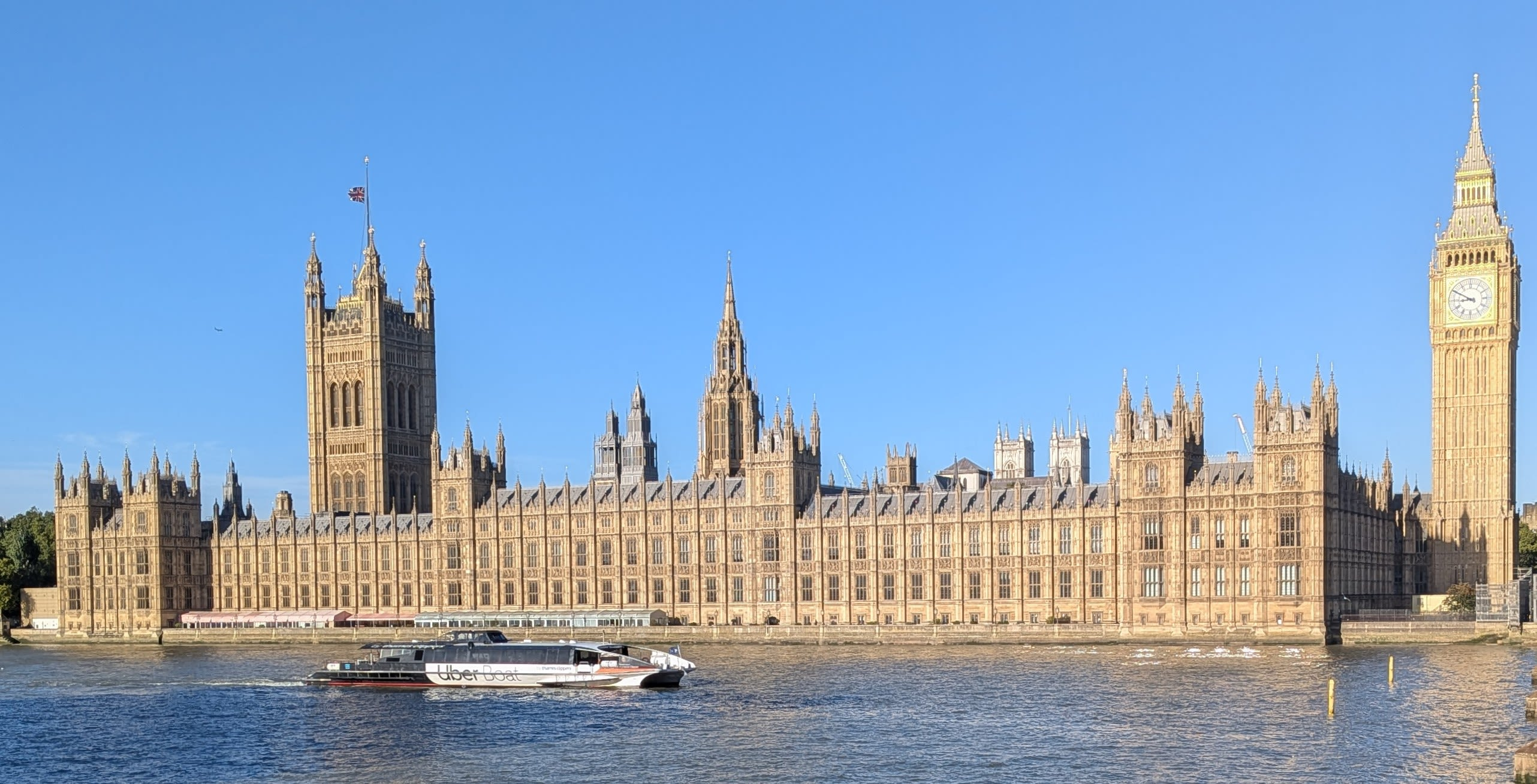
Westminster, where public support for digital ID collapsed almost overnight Photo: George Nall
Westminster, where public support for digital ID collapsed almost overnight Photo: George Nall
December 17, 2025 12:00pm GMT
BY GEORGE NALL
LONDON — Experts were left confused and constituency offices went into panic mode. Over the weekend the government had announced plans to pursue a national digital ID scheme, seemingly out of nowhere.
Polling on the issue in the weeks prior had maintained around 50% support. On paper, it was the sort of reform that usually goes unnoticed. A modernisation, aimed at making services more efficient; in theory reducing waste, saving taxpayers money and reducing fraud. But new data, collected just days after the government formally announced plans to pursue the scheme, showed support had dropped to just 38%.

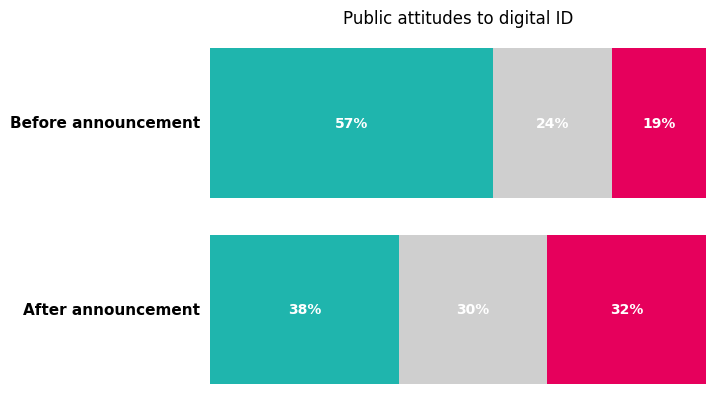
Public attitudes to digital ID before and after the government announcement. Sources: Ipsos; YouGov.
Public attitudes to digital ID before and after the government announcement. Sources: Ipsos; YouGov.
A petition titled "Do not introduce Digital ID cards," launched in the immediate aftermath of the Prime Minister's announcement, received nearly 3 million signatures, making it the fourth most signed government petition in UK history. A purely technocratic reform mutated into a major political and civil liberties flashpoint overnight.
This was a failure of messaging. But to analysts and communication experts, the numbers pointed to something more serious than just poor PR. They were the clearest sign yet of what I call the Toxic Messenger Effect: when a policy, no matter how sensible or helpful, becomes impossible to sell simply because of who is promoting it.
How did we get here?
There has been a major shift in the relationship between the government and the public in recent years.
"Trust in politicians and government is at an all-time low," says Darren Lilleker, a professor of political communication at Bournemouth University. "It’s moved from being scepticism in government to downright cynicism... People just don't trust governments to get things right".
The Digital ID scheme is a clear victim of this shift. People supported the idea in theory, but the government adopting the position caused the public to turn against it, leading to a collapse of support in polls.
"People might support the idea in principle. But when it actually comes to implementation, they get scared," says Harry Bradshaw, Communications Director at the Centre for Social Justice. "They're like, 'Well, if you'd asked me if I wanted to do this, then I would be in favour of it. But you've just sprung it upon us a year in'".
"Announcing a policy so suddenly without putting it through an election campaign means that the argument hasn't been had," Bradshaw explains.
In the absence of debate, an "unusual alliance" including all opposition parties and some labour backbenchers, formed against the government's agenda. Attacks from both the left and the right spread across social media.
The speed of the rollout caught even government adjacent communications staff by surprise. Charlie Chushway, Communications Officer for Jessica Toale MP, describes the chaos: “It did come out of the blue, this policy. I think it happened over the weekend, and we didn't have any warning that it was going to happen. So we needed some time to sort of properly understand the policy before we communicated on it.”
"We made a strategic decision to let the initial storm blow over," Chushway says.
"Sometimes the worst thing you can do is wade into a fight when the framing is already really toxic and negative, and people just aren't ready to listen."
This rejection was about the government's perceived competence. "It also felt to me quite reactive... people think: Oh, has this been thought through? Has there been a review? Has there been any sort of independent consultation on this?" notes Bradshaw. If people see the messenger as incompetent, they often assume the message is flawed also.
In much of Europe, the debate over digital identity is very different. Many European countries had already introduced or were developing digital ID systems that are widely used and accepted, long before the UK’s proposal caused controversy.
Countries like Estonia have been issuing digital IDs since the early 2000s. These IDs are now a part of daily life and are widely supported, with around 85% of Estonians in favour.
They let people log into government services, sign documents, vote, access healthcare online and are widely considered the gold standard of digital identity in Europe.
The idea clearly has merit, but thus far, British politicians have been unable to sell it.
“The digital ID resistance isn't really about the technical specifications of the system. It is a proxy for something deeper. Can I trust the state with this power? After everything that's sort of happened in recent years with data breaches, surveillance concerns, COVID, and just general government sort of dysfunctions, there's been a real erosion of trust in the state and government.” – Charlie Cushway
Reverse Midas Touch
Poor messaging causing a good policy to fail is not new, but it is becoming more common. Jeremy Corbyn’s manifesto from 2019 was widely liked but electoral results for him never materialised.
"A lot of people agreed with his policies, but didn't seem to like him," Lilleker explains. "His policy message couldn't cut through, even though it was popular".
This leads to a contradiction: people support a policy on its own merits, but when it is linked to a political party or a specific politician they distrust support drops.
"If the individual is disliked or mistrusted, people will kind of adopt their partisan position," Lilleker says. "We have seen in experiments that they will automatically choose the policies of the parties that they already support, even if they're misaligned [with their actual views] in some way".
Cushway suggests this phenomenon is due to motivated reasoning. "If you already distrust politicians, or you're already sceptical of Labour, it almost doesn't matter what the policy actually is, you'll find a reason to oppose it. The emotional response to the messenger happens first. Do I trust this person? And then the analytical brain works backwards to justify that feeling.” Cushway explains. “It’s not that people are stupid. It’s just how human cognition works under information overload."
This problem strikes at both sides of the aisle. Theresa May’s failed social care reforms, labelled the "Dementia Tax" by the media and opposition parties, greatly hampered her electoral outlook in 2017. Reuters reported that “An ICM poll showed the lead of May's party had contracted to 14 percentage points from 20 points” just one week prior.
"It was actually policy choice and the framing of it that made her become the toxic messenger," Bradshaw argues. By the media’s framing of her as attacking the party's core supporters, primarily the elderly, she isolated her base and became the problem herself.
A History of Crisis
"This shift is a combination of the global economic crisis, the chaotic handling of Brexit, and the chaotic nature of Covid," Lilleker says. "All of these issues just increased that sense among the public that politicians are not necessarily the best people to run things".
The impact of recent governments is still strongly felt. The chaos of Boris Johnson’s time in office, followed by the quick collapse of Liz Truss’s leadership, has left the public deeply distrustful.
Bradshaw calls the Truss "mini-budget" possibly the "worst example of messaging in recent history.” By failing to prepare or consult her own party, Truss destroyed herself and with her any credibility her government had left.
"Whatever this person says... they will be damned if they do, damned if they don't," Bradshaw says, "A politician in a certain time and climate, will not be able to get it right... because they're not trusted, or because people think they have naïve secondary intentions".
This idea of "naïve secondary intentions" was fatal for the Digital ID scheme. The public’s response must be understood within a broader historical context of government initiatives that were perceived as infringements on civil liberties, such as the proposed identity cards in the United Kingdom during the early 2000s, which were ultimately abandoned due to widespread opposition.
In a climate of low trust, people do not see the government as simply trying to be efficient with digital centralisation. Instead, they see it as "Big Brother" going too far.
Ironically, "If they want a Big Brother to watch, there it is in their pocket," Lilleker says, referring to smartphones.
Media and the Death of Nuance
The 24 hour news cycle and media environment we live in has the ability to speed up political discourse. Sentiment can shift quickly, leading to sudden U-turns or the government backing down over unpopular issues.
"I think that's where social media comes in and where media can start to ask questions and frame things in a certain way and make people believe something is going to be more important than it actually is," Lilleker says.
The constant need to "create news every morning, every afternoon and every evening" pushes politicians to react quickly and the media to seek controversy rather than focus on policy details. "It just creates that perpetual 'oh, it can't go on like this' feeling," Bradshaw says.
With the news changing as quickly as it does, it is unreasonable to expect the whole electorate to be up to date and well informed on every issue, allowing clickbait headlines and X (formerly Twitter) posts to dictate the national conversation.
“People don't necessarily take the time to research the full picture.” Cushway says, “They place their trust in a news source. And if that source is biased, which it often can be, the negative framing is what sticks. Once that takes hold, it's incredibly hard to shift.”
Shifting negative framing in a post truth world isn’t as simple as just offering factual clarifications. If the electorate don’t believe the government has good intentions they will interpret any attempt to clarify or explain as backtracking.
This is particularly damaging for reforms that take time and require public involvement to succeed, like digital identity systems.
When trust in government remains low for an extended period of time it changes how power is exercised. Stagnation becomes preferable to public embarrassment.
Politicians, afraid of bad press, avoid bold reforms and honest discussions of difficult choices. Instead, they offer easy answers that do not fix real problems, which leads to more failure and even less public trust.
"The things that the people want actually need bigger changes in the way the world works," Lilleker observes. But governments are "hostage to many, many global forces," and their inability to control these forces makes them look weak or dishonest in the media when they promise solutions.
When nobody trusts anyone
When nobody is trusted, power doesn’t disappear; it moves.
In a highly polarised political environment, where policies are judged by the person proposing them and not on their own merit, for or against becomes political signaling. Actually evaluating policy is left by the wayside.
“Once trust collapses, politics stops being about problem-solving and becomes about tribe,” says Bradshaw. “People aren’t asking ‘is this a good idea?’ anymore. They’re asking, ‘Who benefits if I agree with this?’”
In these conditions, compromise can become politically risky. Attempts at cross-party consensus or bipartisan support risk alienating a core base that defines itself by opposition.
This is how populists win.
When mainstream institutions are widely distrusted, figures who position themselves as outsiders, unbound by convention or expertise gain a massive strategic advantage. Populist leaders thrive not because they are trusted, but because they redirect mistrust towards a common enemy: “the establishment,” “the elite,” or “Westminster.”
Bradshaw points to international examples where this dynamic has already taken hold. “You see it very clearly in the United States,” he says. “Policies that would normally attract bipartisan support suddenly become toxic simply because of who is associated with them.”
This has consequences beyond a single policy failing. When disagreements over issues become symbolic, compromise becomes nigh-on impossible, as any movement towards it is framed as betrayal. The centre is eroded and pragmatism vanishes, leaving only performance politics.
Voters, frustrated by years of ineffective government and national crises, either get on board or check out entirely. Not apathy, disillusionment.
As trust in political institutions erodes, citizens are turning away from traditional politics altogether. Instead, they favour campaign groups, social movements that align with their beliefs, or online communities within their respective echo chambers.
Lilleker argues that this is self-reinforcing, as "when people feel that the system doesn't work for them, they pull back and when they pull back the system becomes less representative."
Democratic participation is at a historic low. Fewer people are members of parties, and voter turnout at national elections has been steadily declining since 2019, falling to 59.7% in June 2024, the lowest figure recorded since 2001. The result is a dissociation from politics as a whole, people feel that it’s something done for them, not by them.

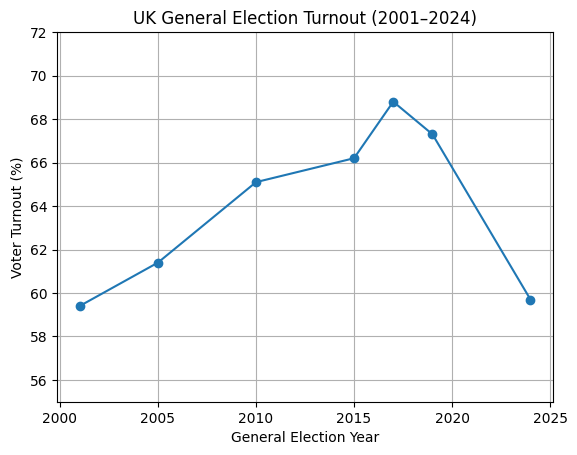
UK general election turnout from 2001 to 2024, showing a 10 year decline in voter participation and a sharp fall in engagement at the 2024 general election. Source: Electoral Commission; House of Commons Library.
UK general election turnout from 2001 to 2024, showing a 10 year decline in voter participation and a sharp fall in engagement at the 2024 general election. Source: Electoral Commission; House of Commons Library.
Successive governments are finding it harder to get their way, the process of reform seems much more hazardous, and trust harder to regain.
Is there a solution?
Bradshaw says the answer is not better public relations, but real structural change: "You increase checks on politicians to make them more honest... create a more powerful judiciary and more stringent consequences for politicians not meeting the promises".
Cushway thinks national messaging is not the answer. “I have to be optimistic and say that I think it's reversible. But I think it requires sustained, consistent and authentic local engagement,” Cushway argues.
“Research suggests that personal contact, repeated positive interactions, and visible problem-solving can help rebuild trust over time. So an individual MP can overcome the toxic messenger effect in their constituency, through a lot of hard work, visibility and improving over the years that they're there for residents.”
National messaging alone is not the solution. For the government to make meaningful progress restoring its image, actions will have to speak louder than words. Attempts to manage populism from the top down are likely to fail as any argument is seen through the lens of years of political indecision, scandal and broken promises.
What is clear is that the government has a long way to go. According to the Edelman Trust Barometer, trust in the UK’s government sits at around one third of the population, ranking Britain amongst the lowest of all western democracies. When a government is disstrusted to this extent many forces are working against it: media and social media attacks, lack of support at a local level and internal political preservation instincts mean making bold reforms is considerably harder.
With Reform and the Greens attracting disgruntled voters from the two main parties, it remains to be seen if the political establishment can meaningfully regain its credibility and authority.
 Built with Shorthand